Some icons never truly disappear.
They simply wait for the right moment to return.
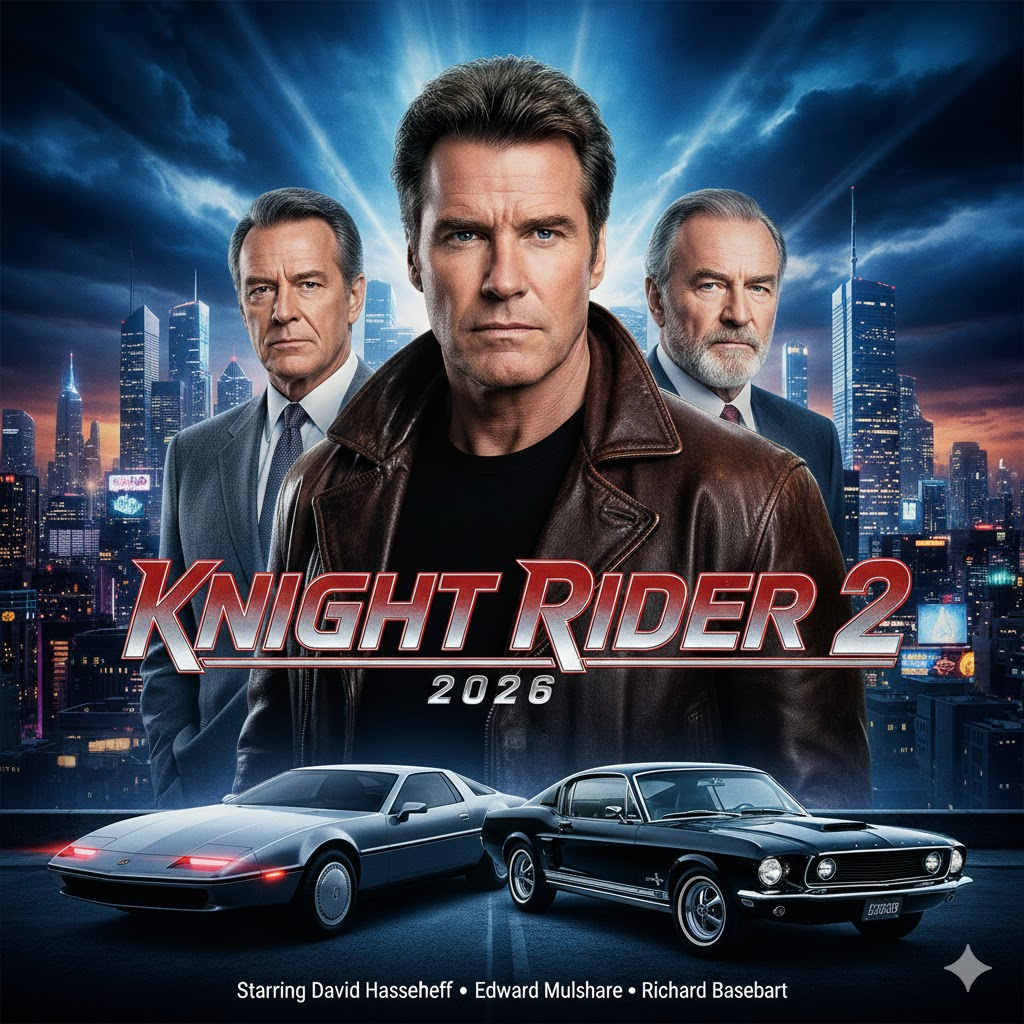
In recent days, social media has erupted with excitement over Knight Rider 2 (2026) — a rumored sequel said to mark the return of David Hasselhoff as Michael Knight. Explosive visuals, dramatic fan-made trailers, the roar of an engine cutting through a futuristic skyline — all of it creates the irresistible illusion that a legend is about to ride again.
But behind the adrenaline and neon lights lies a pressing question:
Is this truly the rebirth of an icon — or merely a digital-age mirage?

A Legend in a New Era
The circulating storyline paints a world where artificial intelligence is no longer a tool — but a dominant force. A sophisticated cyber-terrorist organization unleashes an advanced AI virus capable of seizing control of satellites, transportation grids, and even global defense systems. Civilization teeters on the brink of systemic collapse.
In this chaos, Michael Knight — once the man who believed technology could serve justice — is forced out of retirement. He is no longer the fearless young operative of the 1980s. Time has left its mark. Experience has sharpened him. Doubt may even haunt him.
K.I.T.T., too, has evolved. No longer just a high-performance supercar, this upgraded version reportedly features quantum processing, adaptive combat systems, and near-sentient intelligence.
But if AI can learn… evolve… and think beyond its programming —
can it still be fully controlled?
If Knight Rider 2 were real, it would not simply be a high-speed action spectacle. It would be a meditation on control versus autonomy, innovation versus consequence — and humanity’s fragile relationship with the machines it creates.

The Reality Behind the Hype
Despite the viral buzz, there is currently:
-
No official production announcement
-
No confirmation from Universal, NBC, or rights holders
-
No verified involvement from David Hasselhoff
-
No legitimate studio-backed trailer
The circulating videos appear to be AI-generated concept trailers or cleverly edited fan creations.
Yet their impact reveals something powerful: in an era where digital tools can fabricate cinematic realism within minutes, a film doesn’t even need to exist to feel real.

Why We Want to Believe
Knight Rider was never just about car chases. It symbolized optimism — a belief that technology could be ethical, loyal, and just. K.I.T.T. wasn’t merely a machine; it was a partner. A confidant. A moral compass on four wheels.
Today, we live in a world of autonomous vehicles, predictive algorithms, and AI systems that write, speak, and decide. The fantasy of K.I.T.T. feels less like science fiction — and more like a prototype waiting to happen.
Perhaps that’s why the idea of a sequel resonates so deeply. Not just because of nostalgia — but because the themes feel urgently modern.
Could the Legend Return?
For now, Knight Rider 2 (2026) remains a rumor — a digital echo fueled by creativity and longing. But the overwhelming response proves something undeniable: the appetite is there.
If revived with maturity and thematic depth — exploring AI ethics, technological dependency, and the cost of progress — Knight Rider could become more than a reboot. It could become a defining story of our time.
Because at its core, the formula has always been simple:
One man.
One machine.
And the belief that technology, guided by conscience, can still protect the world.
The film may not exist.
But the legend?
It’s still idling in the dark — waiting for the engine to start. 🚗🔥