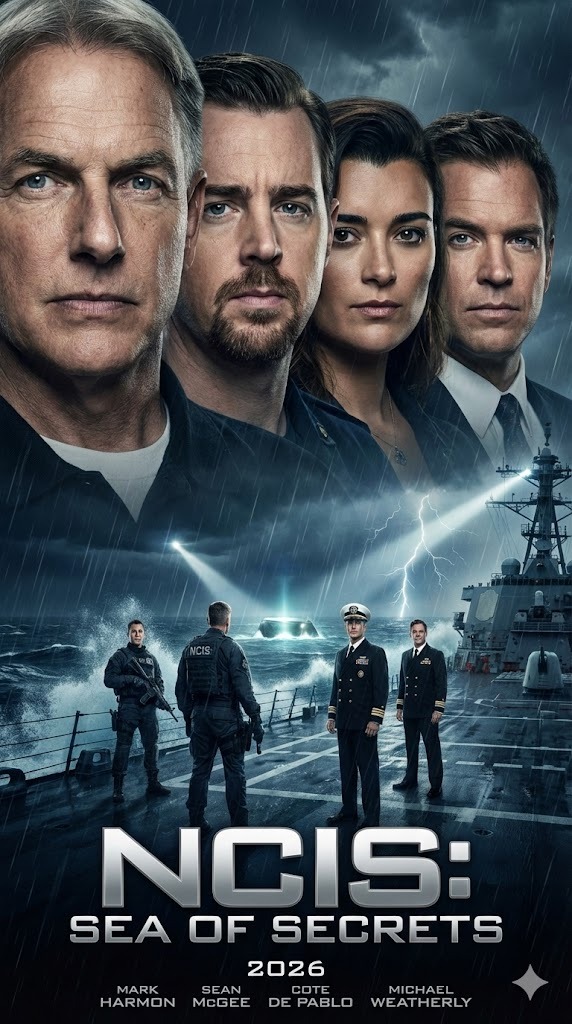
Among all the viral discussions surrounding NCIS: Sea of Secrets, one idea appears again and again: this story does not feel like a normal NCIS season. Instead, it feels cinematic. Fans describe it as a project that could work best as a feature film or a limited series, rather than a traditional procedural show.
What makes Sea of Secrets stand out is not only its story, but the way that story is imagined to be told. From its ocean setting to its darker tone, everything suggests a slower, more immersive experience.
A Shift in Storytelling Style
Traditional NCIS episodes follow a familiar structure. A crime happens. The team investigates. Evidence is collected. The case is solved by the end of the episode.
Sea of Secrets breaks away from this formula.
According to viral descriptions, the story unfolds gradually. Answers are delayed. Clues are incomplete. Each discovery raises new questions instead of closing the case. This creates a sense of tension that lasts across the entire story.
Rather than focusing on fast resolutions, Sea of Secrets focuses on build-up. Conversations matter. Silence matters. What is not said can be just as important as what is revealed.
This slower pacing allows emotions and themes to breathe, making the story feel deeper and more realistic.

A Darker, More Cinematic Tone
Tone plays a huge role in how Sea of Secrets is imagined.
Fans describe the project as darker, quieter, and more atmospheric than standard NCIS. There is less humor. Less casual dialogue. More heavy silence.
The lighting is imagined as muted and natural. Night scenes dominate. Ships are lit by cold artificial lights. Offices feel isolated. The ocean stretches endlessly in the background, creating a feeling of loneliness.
This tone reflects the story itself. When dealing with buried secrets and moral guilt, a bright and energetic style would feel wrong. Darkness supports the emotional weight of the narrative.
The Ocean as a Visual and Emotional Space
The sea is not just a setting in Sea of Secrets. It defines the entire visual identity of the story.
Scenes take place on naval vessels, docks, submarines, and open water. The ocean is unpredictable. Calm one moment. Violent the next. This unpredictability mirrors the investigation.
Underwater sequences are especially important. Divers searching wrecks. Cameras revealing sunken objects. Evidence hidden for years beneath layers of rust and silence.
Visually, these scenes create tension and beauty at the same time. Emotionally, they represent memory. The deeper the team goes, the more painful the truth becomes.
The sea reminds viewers that time does not erase guilt. It only hides it.

Sound, Silence, and Atmosphere
Another cinematic element fans often mention is sound design.
Sea of Secrets is imagined as a quiet story. Wind. Waves. Distant engines. Echoes inside metal ships. These sounds replace background music in many scenes.
Silence becomes powerful. Long pauses in dialogue allow emotions to surface. Characters hesitate before speaking. Truth feels heavy.
When music does appear, it is subtle and slow, supporting the mood instead of controlling it. This restrained use of sound adds realism and tension.
Limited Series Versus Feature Film
Many fans believe NCIS: Sea of Secrets would work best as a limited series of 4 to 6 episodes.
A limited series format allows the story to unfold naturally. Each episode can focus on a different layer of the mystery. One episode may focus on the crime. Another on the past operation. Another on personal consequences.
This structure gives space for character development and emotional arcs. It also allows suspense to build over time, keeping audiences engaged.
Others argue that Sea of Secrets could succeed as a feature film, especially with its focused storyline and cinematic tone. A film would create a tight, intense experience with strong emotional impact.
Either format would be a departure from traditional NCIS — and that is exactly why fans are excited.

A Visual Evolution of the NCIS Franchise
If produced, Sea of Secrets would represent a visual evolution for NCIS.
Camera movement would likely be slower and more controlled. Shots would linger longer. Faces would tell stories without words.
Wide shots of the ocean would contrast with tight close-ups of characters under pressure. This visual language reinforces the theme of isolation and moral tension.
This approach aligns with modern prestige television, where visual storytelling is just as important as dialogue.
Why This Style Fits the Story
The themes of Sea of Secrets demand a serious and cinematic approach.
Stories about institutional failure, moral compromise, and buried truth cannot be rushed. They need time and atmosphere to feel real.
A flashy or fast-paced style would weaken the impact. The imagined tone of Sea of Secrets respects the subject matter and the audience.
It trusts viewers to pay attention. To feel uncomfortable. To think.
Audience Expectations and Impact
Modern audiences are changing. Many viewers now prefer limited series with deep storytelling over long-running episodic formats.
Sea of Secrets fits this shift perfectly.
It offers a complete story with a clear beginning, middle, and end. It promises emotional payoff, not just procedural satisfaction.
For longtime NCIS fans, it offers something familiar but bold. For new viewers, it offers an accessible entry point with a strong narrative hook.
Final Thoughts
NCIS: Sea of Secrets (2026), as imagined through viral storytelling, feels like a natural evolution of the NCIS universe.
Its cinematic style, ocean atmosphere, and serious tone set it apart from traditional entries. Whether as a limited series or a feature film, it has the potential to deliver a powerful, emotional experience.
At its core, Sea of Secrets is about uncovering what was hidden — not just underwater, but within people and institutions.
If it ever becomes reality, it may not just be another NCIS project. It could be one of the most visually striking and emotionally mature stories the franchise has ever told.